
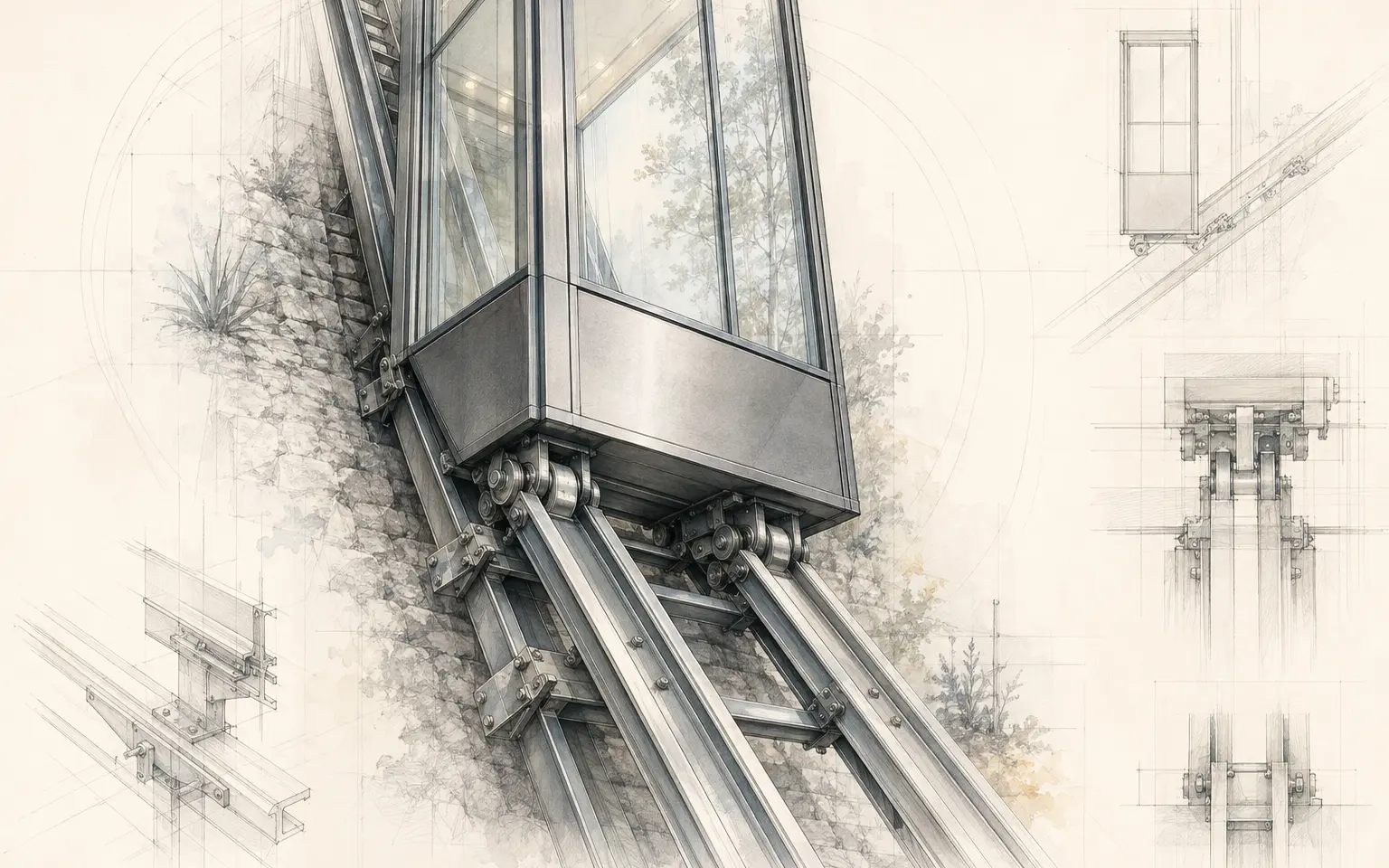
Start by defining the intended use
Passenger use, goods, private occupancy, shared residence and public access are not interchangeable descriptions. The project brief must state who uses the installation and under what conditions. This information affects the design and the competent assessment of the installation.
A goods lift must not be re-labelled for people. A public connection cannot be treated as a private domestic route simply because the cabin appears similar. Clear intended use is a foundational safety decision.
Identify the applicable framework from the real design
The European Lift Directive 2014/33/EU covers lifts and safety components within its stated scope. EN 81-22 addresses lifts with an inclined travel path within its scope. Other systems can require a different analysis.
The website therefore avoids claiming that every hillside cabin has the same classification. F. Labbé and the relevant competent parties confirm the path appropriate to the project once configuration and use are known.
Safety includes the stations and approaches
Users encounter paths, doors, thresholds, lighting and balustrades before they experience the moving cabin. A well-designed machine does not correct a slippery approach or an unresolved level change. Building and landscape interfaces are coordinated with the responsible designers.
Outdoor stations need water and weather detailing that preserves access. Public or unfamiliar users may also need clear information and an understandable route.
Design access for inspection and intervention
Technicians require safe, defined access to relevant parts. Planting, walls and architecture should not conceal or block that path. Installation logistics and maintenance access can overlap, but both need explicit review.
Emergency and fault procedures depend on the completed system and operator. They are documented for the project and should remain available after changes in owner, managing agent or staff.
Testing and documentation are installation-specific
Design review, manufacturing checks, installation adjustment and required assessment form a chain. A component statement is not a declaration for an entire site, and a visual rendering is not evidence of conformity.
Handover records what was supplied and under which conditions it may be operated. Performance, capacity and safety claims should match those documents exactly.
Keep regulation connected to professional judgement
Standards and directives are essential references, but they do not design the route or resolve a retaining wall. Architects, engineers, manufacturer, assessment bodies, operator and authorities each contribute within their competence.
The credible approach is to state what has been verified and what remains open. This is more useful than publishing a universal checklist that creates false confidence across fundamentally different projects.
Write an unambiguous statement of use
The project should state whether it transports people, which groups use it, whether access is private or public and what objects normally travel with passengers. It should identify the levels served and expected operating context. Ambiguous wording such as service lift or private cabin can conceal requirements that later alter the design.
This statement is shared with designers and competent assessment parties. If use changes during the project, the implications are reviewed before specification and contracts are updated. Safety begins with an honest description of what the owner expects the installation to do.
Distinguish legislation, standards and project specifications
Legislation establishes legal requirements within its jurisdiction and scope. Standards provide technical methods and safety rules that may support compliance. The project specification applies the selected requirements to a defined installation and adds client, site and interface needs. These documents play different roles and should not be cited as if one title automatically approves the whole project.
The competent team identifies the current versions and applicability at the relevant time. F. Labbé does not reproduce paid standards on the website or claim that a general article is a conformity assessment. External references are provided so that readers can understand the framework and discuss it with qualified professionals.
Include civil and architectural interfaces in safety reviews
The moving installation relies on supporting structures and meets building or landscape work at every station. Loads, levels, waterproofing, doors, balustrades, lighting and access can cross contract boundaries. A safety review needs the coordinated project, not only the factory-produced components.
Interface drawings show who supplies each element and which information they rely on. If another contractor changes a level or wall, the effect is reviewed before work proceeds. This prevents an apparently minor building decision from creating a conflict at the cabin entrance or travel path.
Design for expected users and foreseeable behaviour
Residents familiar with a private property behave differently from visitors entering a public station for the first time. Children, luggage, mobility needs and language can influence how clear the route and controls should be. The brief should not rely on every user receiving a personal explanation.
Public and shared projects consider information, supervision and alternative routes within the operating plan. Private projects also benefit from intuitive access and clear instructions for guests. The final details follow the designed system and verified use.
Coordinate risk during construction and commissioning
Before handover, the site contains incomplete structures, open work areas and several contractors. Temporary access control, lifting operations and energisation require coordination by the responsible project parties. The permanent safety features may not yet be available, so the construction plan cannot assume normal operation.
Testing and adjustment occur in a controlled sequence. Findings are resolved and documented before the installation is accepted for its intended use. A launch date should not override outstanding technical or interface issues.
Prepare operating procedures for faults and closures
The owner or operator needs project-specific instructions for responding to faults, arranging technical assistance and communicating temporary closure. The detail depends on whether the site is a villa, condominium, hotel or public facility. Contact information and access arrangements should remain current.
Where an alternative pedestrian route exists, it can form part of user information. A public authority may have broader continuity obligations than a private owner. These arrangements are developed with the relevant operator and competent advisers rather than copied from another site.
Maintain compliance through controlled change
After handover, new landscaping, access control, structural work or changes in use can affect the original conditions. The owner should obtain appropriate review before altering stations, travel-path surroundings or operating arrangements. A visually small change can obstruct technical access or modify an important interface.
Current documentation and maintenance records support that review. They allow future professionals to compare the proposed change with the installation that was assessed and handed over. Long-term safety is a managed process, not a one-time label.
Verify claims made in marketing and procurement
A capacity, gradient range, speed or compliance statement should refer to defined equipment and conditions. Project teams should not copy values from an unrelated installation into a new brief. The manufacturer confirms what applies after the route and use are developed.
Procurement documents can distinguish mandatory outcomes from information to be proposed by the specialist. This supports comparable responses without forcing an unverified technical solution too early.
Manage information across languages and jurisdictions
International projects may use French workshop documents, English coordination and local-language approvals. The team identifies controlling documents and ensures that safety-relevant information is understood by those who use it. Informal translation should not create a different intended use or responsibility.
A terminology schedule and reviewed translations help keep drawings, contracts and handover material aligned. Local competent parties confirm the legal and regulatory expectations in their jurisdiction.
Treat cyber and access controls within the real system
Modern access arrangements may interact with gates, building management or remote communication. Any connected function should be defined and assessed within the supplied system rather than added informally by another contractor. The project team records interfaces and responsibility for ongoing management.
The website does not claim remote functions that have not been verified for a project. Access convenience, privacy and dependable operation are considered together when such features are part of the actual brief.
Use independent competence where the process requires it
Some verification and assessment roles must be carried out by appropriately competent or independent parties according to the installation and applicable framework. Their involvement should be planned in the programme and budget, with the information they require identified before completion.
F. Labbé describes its own design, manufacturing and installation scope honestly. It does not imply that the manufacturer replaces every authority, consultant or assessment function needed for a particular project.
A responsible website cannot certify a future project
Online guidance can explain terminology, identify recognised references and show the questions a competent team will ask. It cannot know the final geometry, components, intended operation, civil interfaces or jurisdiction-specific process. A claim that every proposed inclined cabin is automatically compliant would therefore be misleading.
F. Labbé uses the website to prepare better conversations and then confirms project information through the appropriate design and verification process. Clients should expect that progression from education to evidence. It is the foundation of credible safety communication. When a project changes, the evidence and responsible reviews must change with it; an earlier assumption cannot be carried forward simply because it once appeared in a presentation. The current signed project documents remain the controlling reference.