
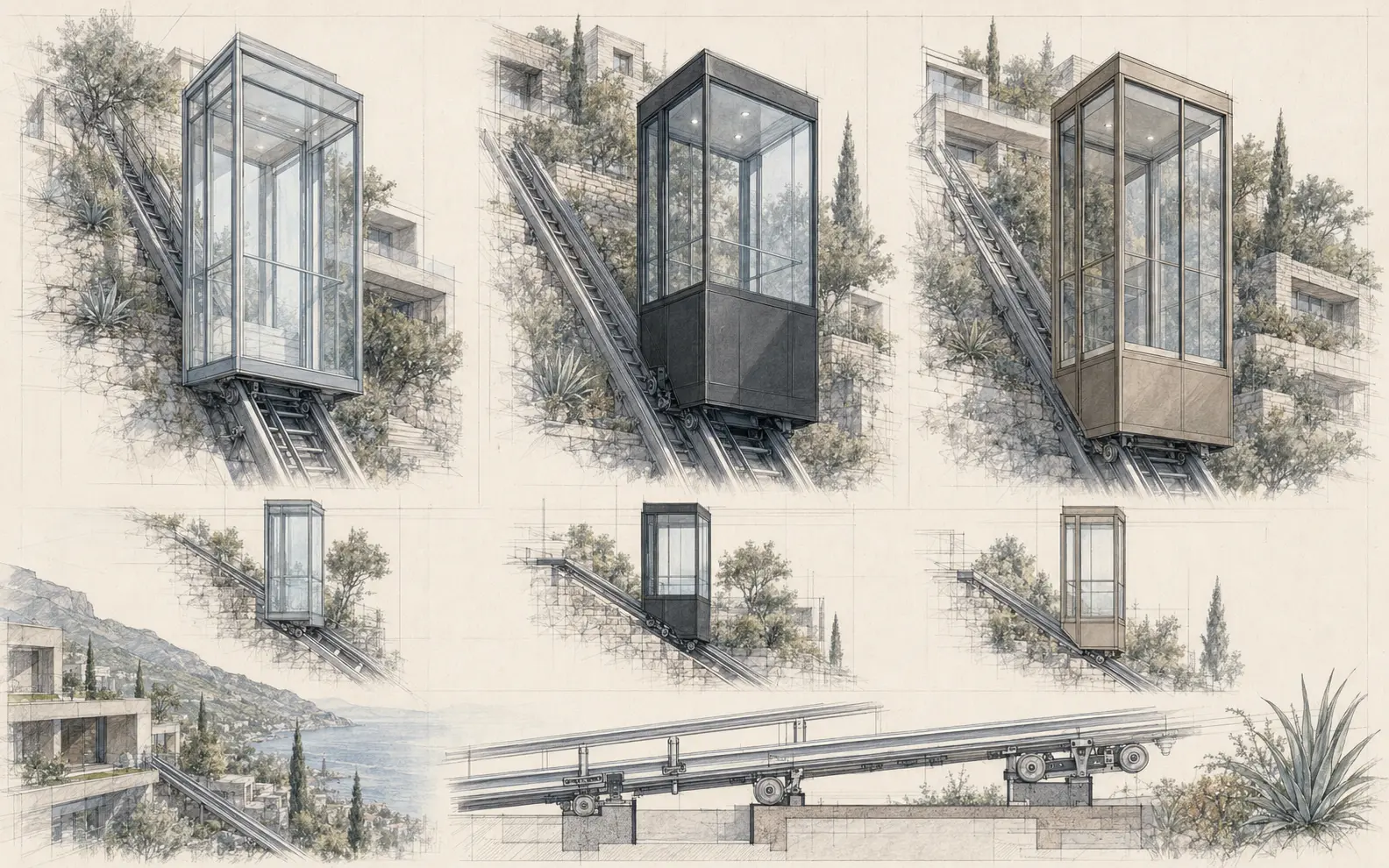
Everyday language and engineering language overlap
Owners often call any private cabin on rails a funicular. This is understandable and helps describe the desired experience. Engineering documents need more precision because traction, guidance, controls, use and route determine the type of installation.
Inclined lift is also not a complete specification. The project must state who is carried, the stations, environment and operating conditions. The correct terminology emerges from the design rather than substituting for it.
A funicular is a guided transport system
In conventional use, a funicular operates on an inclined route and is often cable-driven. Public funiculars may use two vehicles that counterbalance one another, but a private project should not be assumed to copy that configuration.
F. Labbé uses private funicular where it corresponds to the client's search and project language, then confirms the actual solution it can provide after review. No technical property is implied solely by the page title.
An inclined lift carries passengers on an inclined path
An inclined lift is designed around a cabin moving between landings along a non-vertical travel path. Doors, controls and protective arrangements respond to that movement. Outdoor installations additionally require coordinated water, weather and access design.
EN 81-22 provides safety rules for inclined travel paths within its scope. The standard and the European Lift Directive need competent interpretation for the actual project.
Goods lifts and stairlifts are not synonyms
A goods lift is designed for goods and cannot be marketed as a passenger lift without the relevant design and assessment. A stairlift serves a person on an existing staircase. A vertical lift uses a vertical shaft and may be the better response in a compact building.
Separating these families prevents the brief from becoming unsafe or commercially misleading. The decision should follow intended use and geometry, not the equipment name with the lowest initial quotation.
The owner should compare project outcomes
Ask where the route begins and ends, which building work is required, how stations integrate and who maintains the installation. A private funicular and an inclined lift page may describe overlapping user needs, but the final technical answer is project-specific.
Architectural quality, journey comfort, construction disruption and lifecycle access are valid comparison criteria. They often matter more to the owner than a terminological debate detached from the site.
Use precise wording in contracts and approvals
Early conversation may use familiar terms. Drawings, specifications and contracts should progressively state the confirmed system, scope and interfaces. Performance and conformity claims must be tied to the installation that will actually be built.
This discipline gives every participant the same reference. It also allows F. Labbé to describe honestly what it manufactures and where another designer, contractor or authority remains responsible.
Why terminology differs between markets
Private clients, architects and manufacturers may use different words for similar-looking hillside cabins. Translation adds another layer: funicular, hillside lift, inclined elevator and inclined lift do not always carry identical technical meaning across countries. Search engines amplify familiar terms, while contracts require definitions that are precise for the jurisdiction and designed system.
A responsible website can answer the language people use without pretending that language decides classification. F. Labbé therefore explains the overlap and asks for site information before confirming the actual installation. The technical documents progressively replace general words with a defined design and scope.
Compare traction and guidance only after the brief
Different systems can move a cabin along a slope, but selecting one requires more than a preferred mechanism. Route length, gradient, stops, passenger use, maintenance access and local assessment all influence the solution. A mechanism that is appropriate for one property may create unnecessary complexity on another.
Owners do not need to specify traction in the first email. They need to describe the journey, terrain and expected use. F. Labbé can then determine which technical principles belong in the study and what external expertise is required.
Understand the role of the travel path
The travel path includes the geometry the cabin follows and the space that must remain controlled around it. It interacts with supports, stations, walls, planting and maintenance access. An outdoor inclined lift route is not simply a pair of rails placed on the visible ground line.
Changes in slope or direction can have major implications. The design team compares a route that is useful to passengers with one that is technically coherent and constructible. This is one reason product labels and brochure diagrams cannot confirm feasibility.
Distinguish private use from public transport
A private funicular serving one property is not the same project as a public funicular carrying large passenger flows on a timetable. Public transport systems have different operating, capacity, infrastructure and regulatory considerations. Using the same noun does not make their design or procurement comparable.
F. Labbé states which project opportunities it can examine. The site focuses on bespoke private, shared and selected public inclined mobility within the company's verified experience, rather than claiming the capabilities of a mass-transit funicular supplier.
Explain the chosen term to non-specialists
A condominium committee or private owner should not need specialist vocabulary to understand the proposed journey. Presentation drawings can use familiar labels while a note explains the confirmed technical description. This makes communication accessible without losing accuracy in the specification.
The same discipline helps planning and coordination. Neighbours and local advisers see the real cabin, station and route instead of relying on assumptions attached to the word funicular. Clear visuals and written definitions reduce misunderstanding.
Avoid duplicate specifications across different project pages
A villa funicular page, an inclined-lift page and an exterior-installation page may share basic principles, but each should answer a different question. The villa page focuses on daily residential journeys and architecture. The outdoor page focuses on exposure, water and maintenance. The inclined-lift page explains the equipment family and route.
This separation is useful for clients and search engines only when the content remains genuinely distinct. Internal links allow a reader to move between the concepts without repeating the same paragraph under several headings. The final project still draws from all relevant considerations.
Let the contract settle the final meaning
The signed scope, drawings and project-specific documents are where terminology becomes binding. They identify the system, interfaces, performance and responsibilities that have actually been agreed. Marketing copy and early emails cannot replace those documents.
Clients should read inclusions, exclusions and assumptions alongside the chosen technical term. This protects both parties and keeps the project aligned if several languages or local contractors are involved. Precision at contract stage is the natural conclusion of an honest early explanation.
Use comparison tables carefully
A comparison table can organise intended passengers, route, stations, environment, supporting work, operation and applicable verification. It should avoid invented universal values for speed, capacity or maximum gradient. Those figures depend on the system and project, and a table can make a conditional value look like a guaranteed product characteristic.
Qualitative comparison is often more useful at first: which option creates the best arrival, which requires a vertical shaft, which follows an existing stair and which is limited to goods. Technical values are added after the project has enough definition.
Explain the difference to planning and design teams
Local authorities and design consultants may ask for a description that fits their review process. The project team can provide plans, sections, external appearance and the confirmed technical description without relying on a familiar but vague nickname. This allows the proposal to be assessed as designed.
Where terminology differs between French and English documents, a short glossary can state the intended equivalence and identify the controlling project language. This reduces ambiguity for international teams.
Keep search intent separate from equipment selection
A homeowner may search private funicular because it describes the desired result, while an architect searches inclined lift because it is closer to technical language. Both can reach relevant information without the website pretending they are always identical. Internal links should guide the reader toward distinctions, project types and preparation steps.
The design process then starts from the same evidence for everyone. Search wording brings the client to F. Labbé; survey, use and competent engineering determine what F. Labbé can propose.
Choose clarity over a definitive online answer
Some questions cannot be answered responsibly before the site and system are known. Saying that the final classification requires review is not evasive when the page explains exactly which information matters and who needs to be involved. It is more accurate than selecting a term purely to simplify a quotation.
A credible manufacturer helps the client progress from familiar language to precise documents. The result is a project whose name, design and responsibilities remain aligned through approval, fabrication and operation.
A practical answer for owners and architects
Use private funicular when describing the desired residential connection and inclined lift when discussing the defined family of equipment, but do not rely on either word to settle the design. Describe passengers, route, stations, environment and operation. Ask the manufacturer to state what system is actually proposed and which technical framework is being applied.
This approach respects both natural client language and professional precision. It also leaves room to conclude that a vertical lift, stairlift, path improvement or another solution is more appropriate. The project earns its name after it has earned its feasibility.