
Read the article in English.
F. Labbé, a metalworking business based near Nice, specialises in bespoke private funiculars, a type of inclined lift. At prices then ranging from €61,000 to €152,000, these funiculars served villas in Nice, Paris, England and the Caribbean.
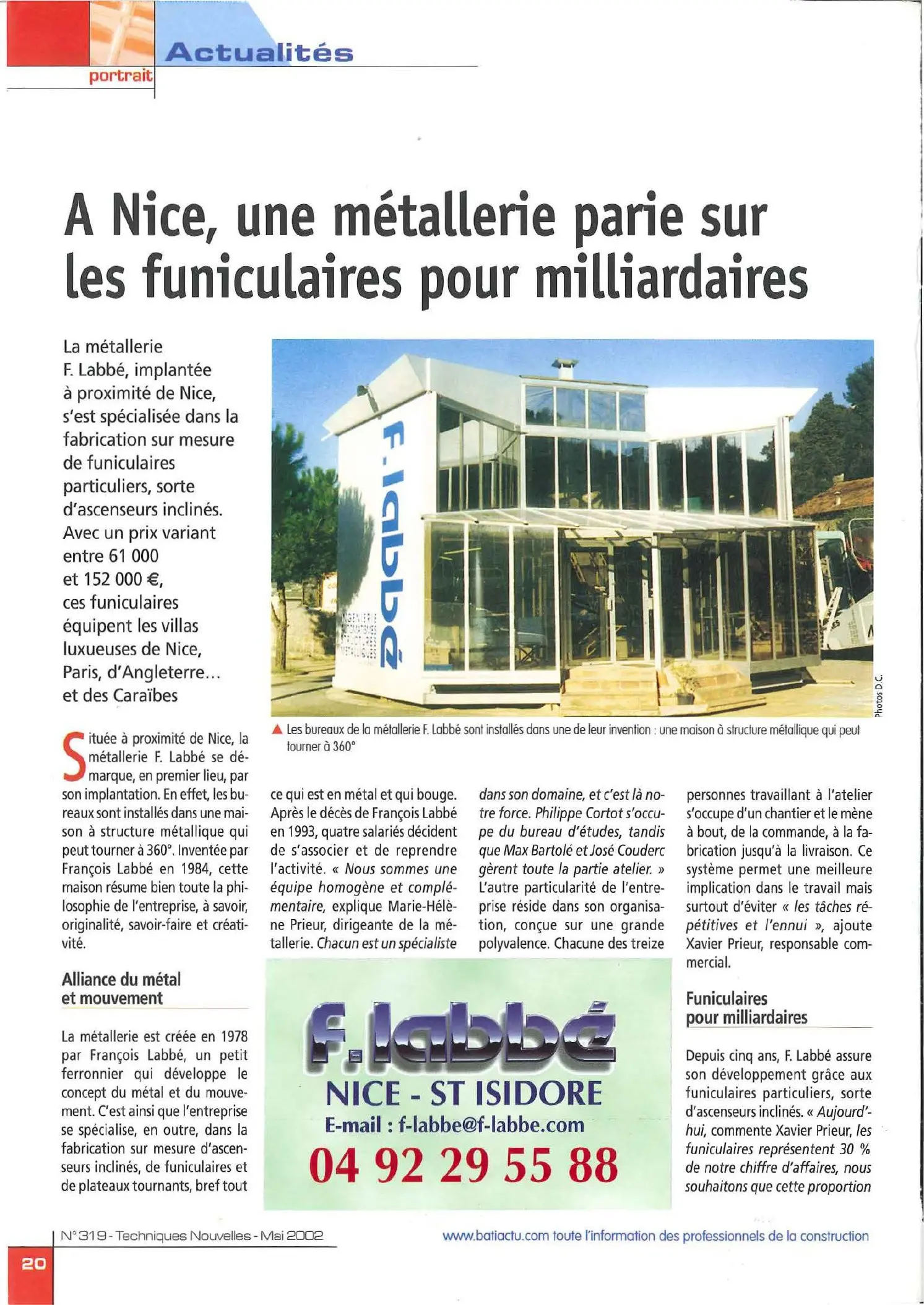
The first thing that sets F. Labbé apart is its location near Nice. Its offices occupy a steel-framed house that can turn through 360 degrees. Invented by François Labbé in 1984, the house embodies what the article sees as the firm’s philosophy: originality, skill and creativity.
Bringing metal and movement together
François Labbé, an ironworker who developed the idea of metal in motion, founded the metalworking business in 1978. The company specialised in bespoke inclined lifts, funiculars and turntables.
After François Labbé died in 1993, four employees decided to become partners and take over the business. ‘We’re a close-knit team and our skills complement one another. Each of us is a specialist in our own field,’ explains Marie-Hélène Prieur, then head of the firm. Philippe Cortot ran the design office, while Max Bartolé and José Couderc managed the workshop.
The article also highlights the team’s versatility. Each of the thirteen people working in the workshop took charge of a project from order through manufacture to delivery. The aim was to give everyone a greater stake in their work and avoid repetitive tasks.
Funiculars for billionaires
For five years, private funiculars have accounted for part of F. Labbé’s growth. Xavier Prieur, then sales manager, explains that funiculars make up 30% of turnover and that the company wants to raise that share to 50%.
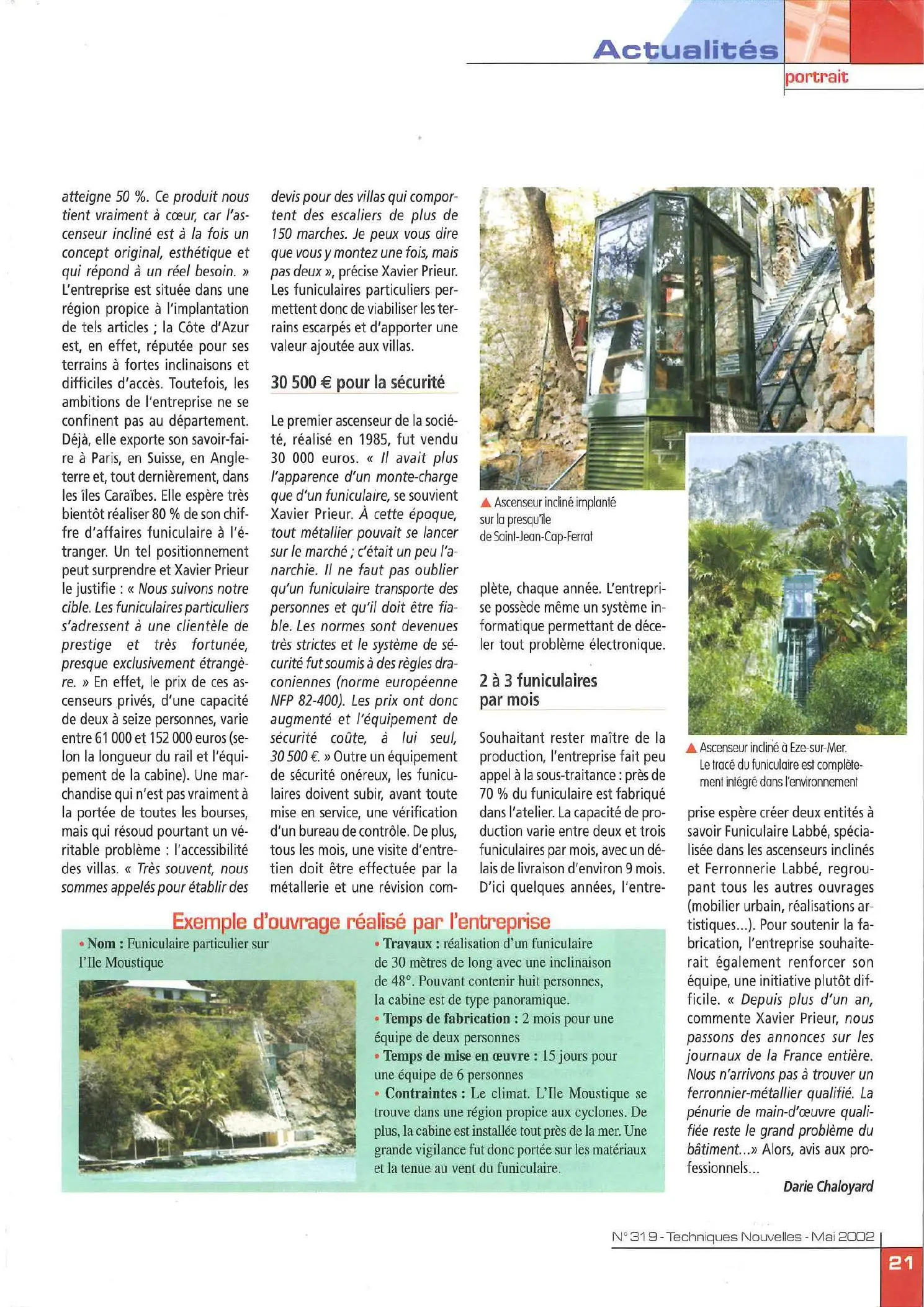
The article describes the French Riviera as particularly well suited to these installations because of its steep terrain. The company also takes its expertise to Paris, Switzerland, England and the Caribbean islands, serving an international clientele whose villas are difficult to reach.
The article cites properties with more than 150 steps. It presents private funiculars as a way to make steep sites more accessible and villas more useful to their owners.
Safety, production and maintenance
The company’s first lift, built in 1985, is described as closer to a goods lift. As the market evolved, the safety rules and checks became more demanding. The article mentions inspections before commissioning, monthly maintenance visits and an annual overhaul, reflecting practices reported in 2002.
Wanting to retain control of production, the company made little use of subcontractors at the time. Nearly 70% of a funicular was reportedly made in the workshop. Production capacity ranged from two to three units a month, with delivery then estimated at around nine months.
The profile closes with the company’s plans for how to organise the business and the difficulty of recruiting skilled ironworkers and metal fabricators. The prices, standards, capacities and lead times quoted are historical figures from May 2002 and do not describe present-day projects.